

What Are Skills?
A Skill is a reusable, self-contained unit of capability. Each one does a single job — and does it well — regardless of which agent happens to be using it. One skill can be composed into many agents, and one skill’s output can feed the next.Skills are like named functions in a codebase — a clear signature, one responsibility, callable from many places.
How to Access Skills
Click Skills in the left navigation, under the Build group. This opens the skills library.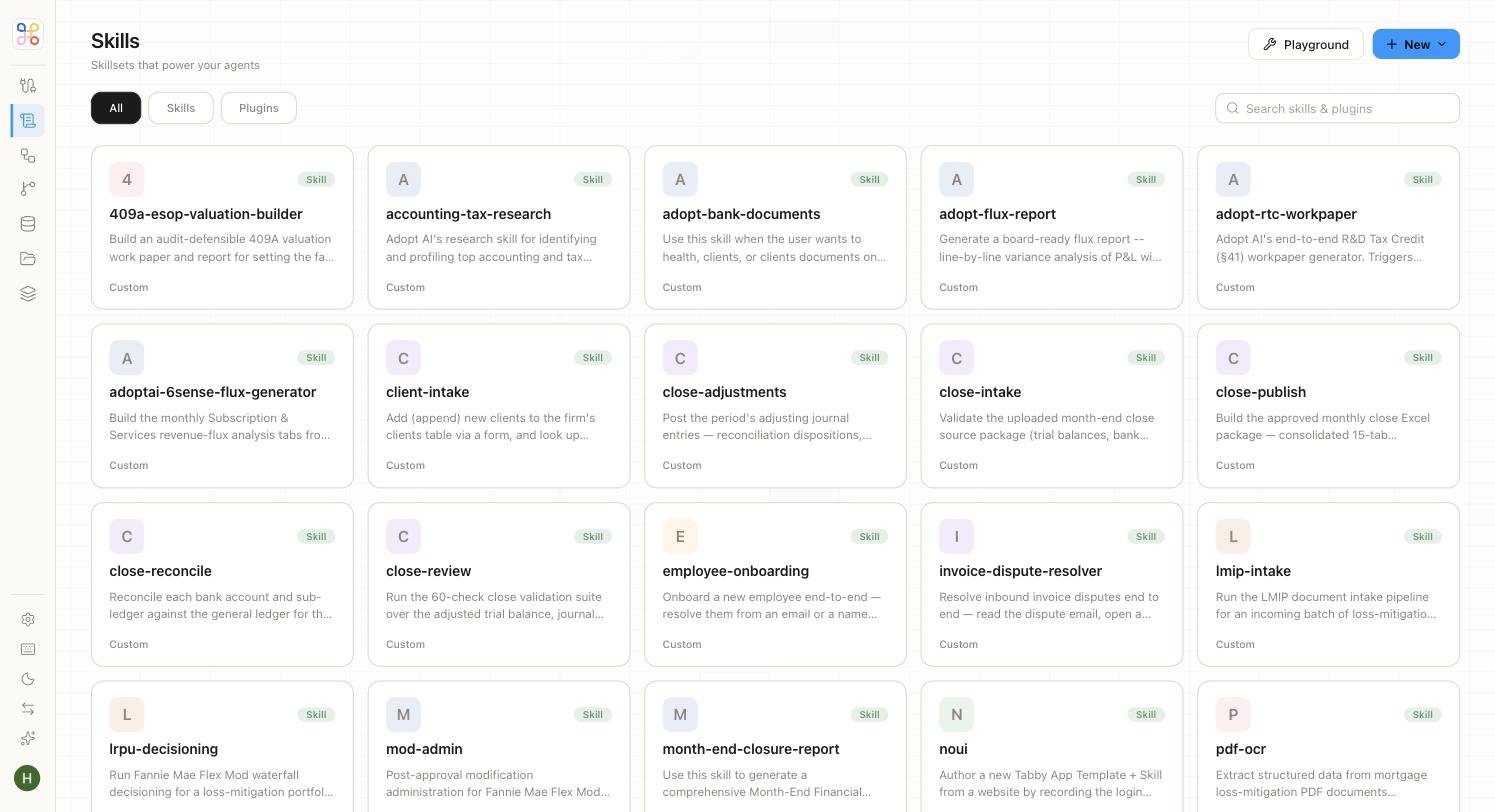
- adopt-flux-report — Generate a board-ready flux report: line-by-line variance analysis of the P&L with plain-English commentary.
- close-reconcile — Reconcile each bank account and sub-ledger against the general ledger for the period.
- 409a-esop-valuation-builder — Build an audit-defensible 409A valuation workpaper and report.
- adopt-rtc-workpaper — Adopt’s end-to-end R&D Tax Credit (§41) workpaper generator.
- client-intake — Add new clients to the firm’s clients table via a form, and look up existing ones.
What a Skill Contains
Every skill is defined by a consistent set of parts. Understanding them is the key to understanding how a skill behaves.Inside a Skill
Open any skill to see its full definition. The detail view puts the skill’s instruction front and centre, with its bundled files listed alongside.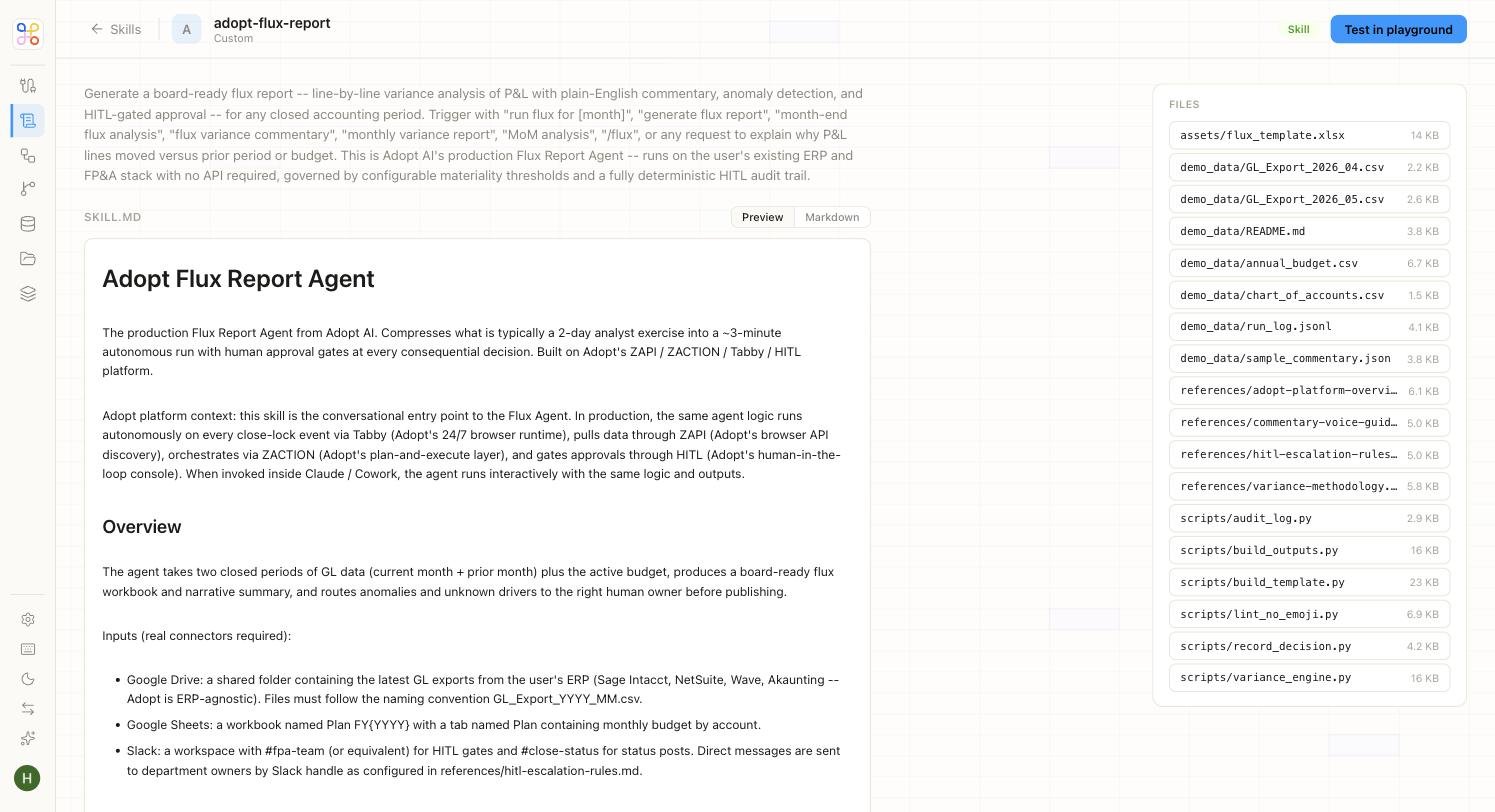
SKILL.MD document you can read as a formatted Preview or as raw Markdown. It lays out exactly what the skill does, the inputs it needs, and how it should behave.
The Files panel on the right lists everything packaged with the skill: report templates, reference guides, sample data, and the scripts that carry out the work. This is what makes a skill portable — the instruction and everything it depends on travel together.
Skills and Plugins
Skills and Plugins live side by side in the library, and both can be composed into agents. A Skill is a single capability you build and own; a Plugin bundles capabilities together for a specific tool or workflow. Use the Plugins filter to view them on their own.Testing a Skill in the Playground
You don’t have to wire a skill into an agent to see whether it works. Click Test in playground on any skill — or the Playground button at the top of the library — to run the skill in isolation against real inputs.Why Skills Matter
Skills are where reuse compounds. Because a skill is self-contained and doesn’t know which agent it lives in, theclose-reconcile skill you build once can power a month-end close agent, a mid-month spot-check agent, and an audit-prep agent — with no duplication. Build a solid library of skills and assembling agents becomes a matter of picking the right ones off the shelf.