

Two ways work gets started
- On a schedule — most agents are set to run automatically (monthly, quarterly, or at period close). You don’t start these; they arrive in your review queue when they finish.
- On demand — you run a task yourself when you need it now (a client asks for something ahead of the cycle, or you’ve just added new files).
Running a task on demand
1
Open the client
Open the client (workstream) you’re working on. You’ll only see the clients you’ve been given access to.
2
Choose the task
Pick the task you want to run — for example R&D Tax Credit or Reconciliations. If several exist for the client, choose the right one.
3
Check the files
Confirm the files it will use are in place. If something’s missing, add it (see Working with clients and files) — otherwise the run uses whatever’s there now.
4
Start the run
Start it. You don’t have to wait on the screen — the run continues in the background.
What happens during a run
The agent reads the client’s files, does the preparation the task describes, and produces output — anywhere from under a minute to several minutes depending on the work. You can watch it progress: each step (pulling data, running the analysis, drilling into details) updates in the run’s Workflow panel, so you can see exactly where it is and whether it’s paused for a decision.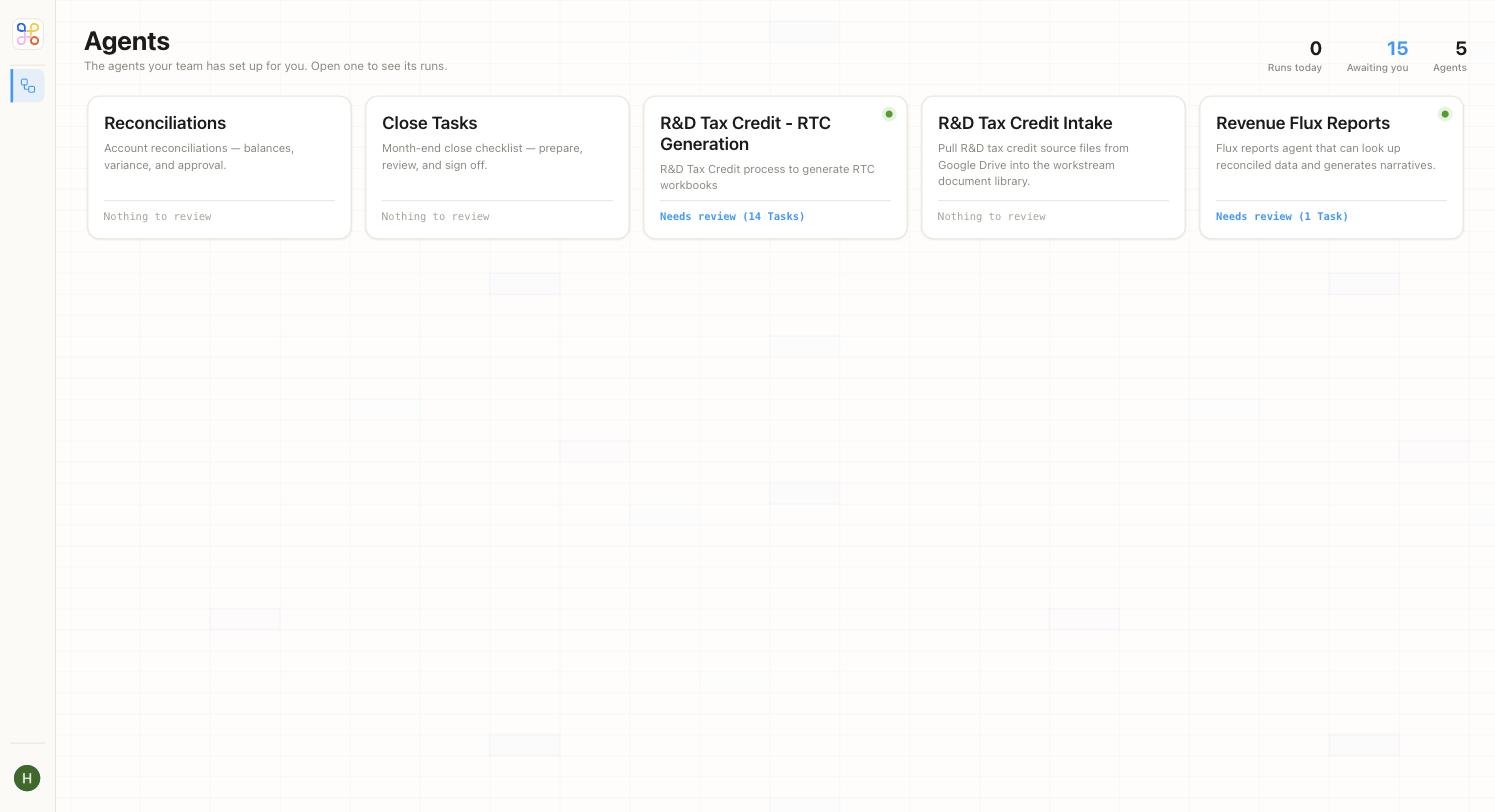
After the run
Everything an agent prepares waits for your review — it is never final on its own. When the run finishes (or hits a gate), it lands in your review queue and you’re notified, if notifications are on.Occasionally a run stops with an error — a missing file, a source that didn’t sync. You’ll see it flagged; see When a run fails.