

Agent
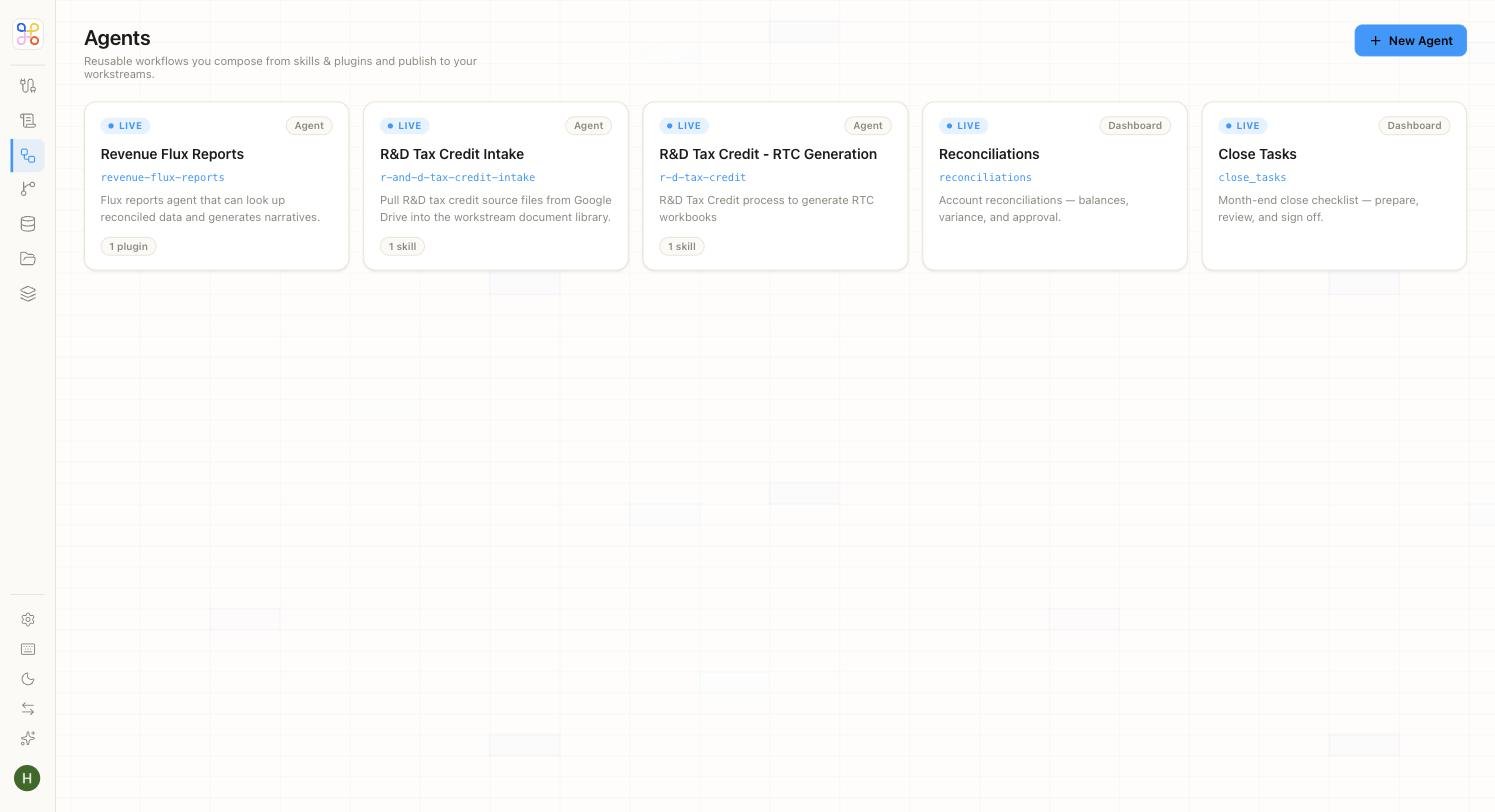
An Agent is the thing that does the work. It has:- a name and a fixed identifier (set once, at creation)
- a description of what it prepares
- instructions — how it should approach the work
- skills — the capabilities it’s allowed to use
- an enabled state controlling whether workstreams can see it
Space
Naming an agent silently provisions a Space — an isolated bucket for that agent’s data. You work in terms of the agent; the Space stays behind the scenes. You rarely touch it directly, but it’s why an agent’s working data stays separate from everything else.Skills
Skills are the capabilities an agent can use. Each skill declares what it does. Common ones:- Read documents — search and cite files in the Doc Store
- Query Data Store — read structured tables
- Generate workpaper — produce a cited workpaper
- Web search — look up public guidance
- Tax Forms — fill and validate IRS forms
DEFAULT (available to everyone) or ORG (specific to your organization).
On the Quick setup path, skills are chosen for you by the task template. On the Advanced path, builders pick them explicitly.